 HopNews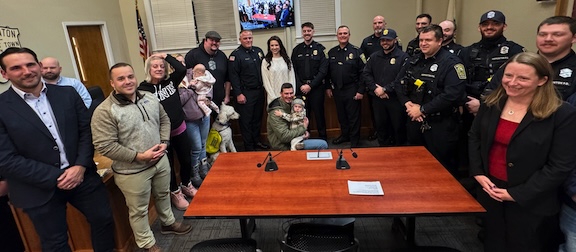
Changes to Format as Board Tackles Multiple Community Issues
The Hopkinton Select Board introduced significant changes to its public forum procedures at its December 2 meeting, while also addressing Lake Maspenock weed management, promoting a police officer to the rank of sergeant, and hearing proposals for a new Fourth of July parade.
Select Board Chair Explains New Public Forum Rules
Before opening the public forum, Select Board Chair Joe Clark outlined new rules designed to improve meeting efficiency while maintaining public access. He’s going back to the two-minute-per-person rule.
“I will give you a heads up so you can finish up your final thoughts,” Clark explained. “Also, I will be capping it at 20 minutes tonight. We’ll go until about 6:20 so that we can move on.”
The new procedures include:
- Two-Minute Speaking Time: Each speaker now has 2 minutes to address the board, down from the previous 2–3-minute limit.
- 20-Minute Initial Period: The public forum will end 20 minutes into the meeting. After the meeting, the public forum will continue. “I want to continue hearing everyone’s thoughts,” Clark said.
- Prioritizing Multiple Topics: Clark wants to hear as many of the different topics as possible first. “I’ll look for someone else if they have a different item to discuss,” Clark explained.
Public Forum Speakers Address Multiple Issues
Lake Maspenock Herbicide Concerns
Don Sutherland, chair of the Hopkinton Sustainable Green Committee’s environmental working group, opened the public forum by urging the board to reject the $55,000 request to expand herbicide use in Lake Maspenock.
“The Hopkinton Sustainable Green Committee urges the board to reject the $55,000 requested for expanded use of several hundred gallons of toxic herbicides to be administered by DPW in Lake Maspenock in 2026,” Sutherland said. “We see this as physically and environmentally irresponsible mainly because this request feeds an herbicide treadmill which doesn’t manage life in the long term.”
Sutherland acknowledged the Lake Maspenock Association’s assessment work but argued that “the use of these chemicals isn’t designed for the health of the lake. It’s meant to harm and destroy life. That’s what makes it effective. And it kills not only one form of life but non-target as well.”
Editor: With all due respect, the last sentence of Mr. Southerland’s statement is not true. The herbicide targeted the invasive plants, leaving the non-invasive plants unharmed. The LMPA website contains extensive information about this treatment, including pre- and post-herbicide maps.
The maps document where invasive plants were located during certified Limnologist inspections and how the landscape changed after treatment. These maps show that non-invasive plants were unharmed. Additionally, the site features comprehensive research spanning years that preceded the difficult decision to use herbicide—a method that was—and always has been—the last resort.
Southerland noted that there are alternative solutions in the 2021 vegetation management plan that the Sustainable Green Committee would be willing to work with the CIG to implement.
Editor: The Citizens Input Group, of which I have been a member for the last three years, has addressed each alternative in the weed management plan. Again, all this is documented and available to the public on the LMPA website. An overview of the CIG’s work is highlighted in the Lake Maspenock Weed Management Presentation below.
CIG meeting minutes from the last 10 years can be found HERE
E-Bike Safety Concerns
Ed Harrow of Spring Lane raised serious concerns about e-bike safety in town, noting he submitted a letter about “barrel racing on Main Street” that was written in jest but highlighted a real safety issue.
“The issue of ebikes in this town, in the state, in the country is uncontrolled,” Harrow said. “It is the only way, in my opinion, that ebikes can be rendered, quote unquote, safe, is to require a license, require them to be registered, and require them to be insured. Putting 12-year-old kids out on ebikes is crazy.”
Harrow recounted a near-miss incident on Wood Street where a young rider was poorly positioned on the road. “This kid was on the curb. He was riding way too far to the right, which you think is where to be, but he was right at a corner. So, I never saw him until I got around the corner.”
He provided the board with documentation, including pictures of damage done by e-bikes, groups of kids on vehicles that “don’t have pedals” and don’t qualify as e-bikes, and information about the car accident involving a minor in front of Town Hall.
Additional Lake Maspenock Testimony
Carol Esler spoke passionately against herbicide use: “They dumped hundreds of gallons of Diquat in our lake. I don’t want to go too long on Diquat. Toxic, banned in many countries worldwide, including the entire European Union. I can’t believe we put it in our lake.”
Editor: Diquot was used sparingly and only on targeted weeds in the lake. Fifty gallons were used on fifty acres. One gallon per acre. Think about that. Again, this information has always been available to the public on the LMPA website. In addition, Joe Baldiga did a fabulous job of presenting what really happened in the Lake Maspenock Weed Management Presentation below.
Esler emphasized ecosystem concerns. “If people who want herbicides talk about balance and health, toxic synthetic chemicals do not cause balance and health within a lake. They destroy life forms, maybe zooplankton, phytoplankton. There are far fewer shore birds the year that they put it in. This is not balanced and healthy. This is degrading our ecosystem.”
Editor: Nobody wants herbicides. The town used herbicides sparingly, successfully targeting only the invasive weeds in the north basin.
As for actual shore birds, they stop at Lake Maspenock during migration. However, many birds look like shorebirds but aren’t (strictly speaking).
- Great Blue Heron – a large wader regularly hunting along the lake edge.
- Green Heron – smaller, often in quiet coves.
- Mallards and other ducks – common dabbling along shorelines.
- Ring‑billed and Herring Gulls – especially in colder months or when people are boating/fishing.
- Bald Eagle and Osprey – documented birds of prey that hunt fish on Lake Maspenock.
Living on the lake, I can attest to the growing numbers of these waterbirds and raptors. Their numbers are growing, not diminishing.
Esler advocated for alternative approaches. “Other things should be in the toolbox, such as diver-assisted suction harvesting, small weed harvesting machines, and aeration. These things didn’t even make it into the toolbox.” ED: They did, look it up.
Don Kaiser continued the herbicide discussion, noting he would join the weed committee “if their charter didn’t read like herbicides are the first choice.”
Editor: That statement is irresponsible and untrue. As mentioned earlier, herbicides were used as a last resort. For clarification, please read the Lake Maspenock Weed Management Presentation below.
He suggested creative alternatives, including volunteer labor with heavy equipment: “Instead of an eight-foot drawdown some year, maybe we do a 10-foot, and we’ve got a lot of guys in this town that have bulldozers and backhoes, and maybe we buy their diesel fuel, and maybe we get some volunteer labor. We could actually do a dry dredge and maybe a short period of time, and maybe for short money if we think about building another island, expanding that island.”
Kaiser expressed concern about the lack of a spring assessment. “They decided not to do an assessment, a survey in the spring. So, I have no idea what the criteria are going to be for doing this herb application or not.” ED: That was addressed below.
Police Response to Swatting Incident
Kevin Narbonne challenged statements made in a press release by Acting Chief Scott Van Raalten in a letter released to the public in response to the October 1 swatting incident at the high school.
“My complaint wasn’t with the HPD doing a good job and dignifying the call as being a swatting incident at the high school. My complaint was with the HPD being unprepared, [without executing a] well-developed plan and protocol,” Narbonne said.
He took issue with van Raalten’s characterization of FBI involvement: “After reading the press release, I couldn’t help but notice van Raalten writing as the acting chief (while Joe Bennett was out on vacation) wrote in such a way that it seemed to be suggesting the FBI had conducted an after-action review of everything the HP had done on October 1st, 2024. That concluded that all the work by the HPD had been done right.”
Narbonne said his investigation revealed a different story: “I can make phone calls. I can hire people to get facts. So, I want to present facts, not fiction. Would you like to know what Leblanc actually did? I’ll tell you what he did.”
Narbonne claimed that FBI Special Agent Brian Leblanc “did not in any way review the entire case as van Raalten claims” and instead only “assessed the HPD actions that day and reviewed the recording itself, not the entire case.”
Lake Maspenock Preservation Association
Sabine St. Pierre spoke on behalf of the Lake Maspenock Preservation Association (LMPA), emphasizing their collaborative work and education efforts.
She detailed LMPA’s community outreach: “We had an awareness campaign that we started in September. We put up a lot of links with Judy Day’s help at ConComm. She did a presentation at our general meeting about what people can do to keep their waterfronts healthy, and how they can prevent unwanted storm runoff, which contributes to the weeds.”
The campaign achieved notable results: “We had 178 hits on our website in September. We put up lawn signs and directed people to our website. We have a specific tab called Lake Health. Normally, we get about 14-15 hits a month, but we had 178 in September. So, it means that people are looking, and we are hopefully educating them.”
St. Pierre also described LMPA’s welcome wagon program for new lake residents, which provides safety items and educational materials on lake health.
Board Introduces “Public Statement” Response
Following the initial public forum period, Clark introduced a new “public statement” feature for this and future meetings, designed to address recurring concerns and board responsiveness.
Reflecting on feedback from recent public forums, Clark acknowledged the disconnect between community concerns and board responsiveness. “We hear a lot of people come to public forums expressing that they don’t feel heard and their questions aren’t being answered,” he explained. From the board’s perspective, many of these issues are addressed indirectly through discussions at subsequent meetings. However, Clark recognized that this indirect approach may not satisfy residents who prefer more immediate and transparent responses to their concerns.
The board’s first public statement addressed three major topics:
October 1 Swatting Incident
Clark detailed the board’s response, noting that it met on December 3, 2024, with public safety and school officials to discuss the incident and lessons learned.
Key follow-up actions include:
- Monthly joint safety task force meetings between police, fire, and schools.
- 65% of fire department staff are trained in Active Attack Integrative Response (AIR).
- 100% of the police force is trained in AIR.
- 300 high school students trained in Stop the Bleed.
- Planned May 1st four-hour tabletop exercise focused on unified command.
“The key takeaways were the importance of ongoing preparedness and the fact that we can never do enough in those situations,” Clark said. “I think all three departments had the shared opinion that we need to continue to do better in those incidents.”
Tim Brennan’s Arbitration
Clark addressed ongoing public questions about the Tim Brennan situation, which has been raised at recent select board meetings. “At the beginning of the year, the select board took counsel’s advice to step back from the matter once it entered arbitration,” he explained. “The board remains of the opinion that we should stay out of that process,” maintaining the position recommended by legal counsel throughout the proceedings.
Hillers Pizza License Issue
Clark explained that the Domestic Violence Act of 2014 requires that “incidents involving domestic violence, rape or sexual assault be withheld from publicly posted daily log. The log requires that these must be kept in a separate log, which is not a public record, nor shall the entries be disclosed to the public.”
Regarding sex offender information: “Information about level one offenders is confidential and cannot be released to the public. Information about level two offenders may be shared only upon request, and police officers may not proactively release it to the public; information about level three offenders must be distributed to the community. These restrictions are required by state law.”
Clark concluded: “We want to try this as an effort to directly respond to the things that you guys bring up because we do care. It’s not always easy to respond. We certainly can’t legally right away, but hopefully this helps everyone feel that we are responding as we go through things.”
Robert Ekross Promoted to Police Sergeant
In a highlight of the meeting, the board unanimously approved the promotion of Robert Ekross from senior patrol officer to sergeant in the Hopkinton Police Department.
Police Chief Joseph Bennett introduced Ekross as “a candidate that came out on top. He’s well qualified. He’s very active within the department. He serves many roles in training and field training.”
Deputy Chief Scott van Raalten explained the rigorous promotion process governed by the union contract. Candidates must score 70 or above on a written test (40% of final score), participate in interviews conducted by department leadership and HR (40% of final score), with the remaining 20% based on the chief’s assessment, including seniority, performance evaluations, and department activities.
Ekross detailed his seven and a half years with the department: “I am one of the field training officers. So that’s when we bring in brand-new hires, and then they ride with us in the car. We’re showing them everything from the roads to making arrests, going through the cell area, investigations, all that kind of stuff. So, I’ve actually done that for 20 plus officers now.”
He highlighted his expanding role: “Recently, I became a ballistic shield instructor. We have shields that we carry in the car. Became an instructor for that. So, happy to train the officers on that. And just anything that I can get involved with. I do a lot of the social media, our posts that we make on Facebook, I get involved with that. Health and wellness team member, I get involved with that.”
Ekross emphasized the department’s focus on officer wellness: “With the help of Chief Bennett, we got a lot of new gym equipment for the department. Recently, we did a lot of testing for the officers to see if they had any blood issues or cardiac issues. We had a company come in. We were on the assault bike. We were all hooked up with the oxygen and doing all that.”
Vice Chair Shahidul Mannan praised Ekross: “I have interacted with Mr. Ekross a few times, quite a few times, on Main Street and other places, and I was really impressed with his professional demeanor and all the good work he puts in for Hopkinton.”
When asked about his certifications, Ekross detailed his training as an instructor in nonviolent crisis intervention, a three-day intensive course that included dispatchers and firefighters, not just law enforcement.
“It was intervening in situations where someone might be in a state of crisis, but you don’t want to go, you know, sometimes the police have to go hands-on, but it’s kind of talking them through things,” Ekross explained. “We went through the progression of when you’re at the talking stage, kind of seeing what they’re giving off, what their body language is saying.”
Board member Amy Ritterbusch expressed appreciation for modern police training: “I think it’s exciting to the public because you know modern policing has changed a lot over the years. People may not even know that you do that sort of training.”
Clark emphasized the significance of the promotion: “Promotions like this, there’s not a million of them in front of you. I think it’s a significant thing for you, your family, and the department. I think what it says to have someone that’s been in town for a while now move up in the department, continue what we have going.”
The board unanimously approved the promotion, and Ekross’ family joined him for a pinning ceremony conducted by Chief Bennett.
Congratulations to Sergeant Ekross!
Lake Maspenock Weed Management Presentation
Joe Baldiga, chair of the Citizens Input Group (CIG), officially known as the Lake Maspenock Weed Management Control Advisory Group, presented a detailed update on weed control efforts and the $55,000 budget request.
“We certainly don’t want to do anything that’s going to harm the lake, and I respect the comments from the other folks who have spoken in opposition to what we’re proposing for the weed control,” Baldiga began. “I respect their comments because I think we all share a common goal, which is to keep the lake as healthy as possible.”
Background and Previous Treatment
Baldiga recapped the situation. “In the spring of 24, we did obtain ConComm approval to have herbicide treatment applied because the measures taken in advance of that simply were ineffective. They didn’t work anymore, and the primary tool in the toolbox until then had been the annual drawdown. Every third year was an extended drawdown.”
The challenge, he explained, is weather-dependent. “To make the drawdown work, you have to have an extended period of cold weather without snow cover. Right? So, when the lake is at its lowest, like it is right now, you have to have weeks of cold, frosty weather below freezing that’s going to kill the weeds.”
He noted the last effective drawdown was 2015-16. “We had like six weeks of cold weather without snow cover. We haven’t had that for 10 years. We’re not so far having it this year either.”
The 2024 herbicide treatment was effective but didn’t carry over to the second year. “The herbicide treatment worked remarkably well, and we had no weeds that summer, and the targeted weeds were gone. But it didn’t carry over into the second year. We were hoping for a strong drawdown. It didn’t happen last winter. So this summer, the invasive weeds were back.”
Addressing Misconceptions
Baldiga directly addressed concerns raised during the public forum. “You’ve heard comments from some of the opponents about creating a ‘desert’ [meaning, devoid of plant and wildlife], and a vacuum, just making it a barren lake—that’s absolutely not the case. Please read the report; it’s on the LMPA website. The herbicides that are applied are very targeted to just the invasive weeds.”
The spring weed survey was eliminated because it was conducted too early (late May to mid‑June) to detect new weed growth.
Lake Maspenock Weed Survey Reports fund HERE.
He clarified what was actually treated. “The weeds that were killed were the invasive milfoil, the fanwort, and the pondweed. The invasive weeds. There are plenty of weeds in the lake, even right after we treated it. The fish were plentiful. The waterfowl were plentiful.”
Regarding dosage and application, Baldiga provided specific details from page six of the conservation materials. “It’s a 50-acre area because we’re just applying it to the north basin, because that’s where the shallow water is. Solitude applied diquat at one gallon per acre and Aquathol at three gallons per acre. 185 total gallons of chemicals over 50 acres.”
He emphasized the targeted nature. “It is so minimally applied. It quickly spreads in the water, and none of it falls to the bottom except for what’s killing the weeds. It was not just dumping hundreds of gallons into one concentrated area.”
The Toolbox of Alternatives
Baldiga walked through page five of the conservation materials showing all approved methods: drawdown, extended drawdown, benthic barriers, hand harvesting, mechanical harvesting, and herbicide treatment.
On dredging: “We got estimates of what it would take to dredge. And dredging doesn’t last long. You’d have to do it every two or three years. A million bucks to do the dredging for a year. And you need someplace to put all the dredge material.”
He noted topographical challenges: “You can’t walk 5 feet without hitting a boulder. So it’s not an easy lake to dredge, because you first have to address the topography. What are you going to do about the boulders? I don’t know that the state is ever going to approve us bringing a backhoe in there and moving the boulders.”
On mechanical harvesting: “It’s like mowing the lawn. All you’re doing is taking the tops off the weeds. They grow back. You would have to keep mowing the lawn. It’s not feasible. It’s not cost-effective.”
On hand harvesting and benthic barriers: “Small areas. Sure. Maybe in front of your dock. But it’s not feasible for 50 acres where the weeds are prevalent in that entire 50 acres.”
The CIG respects the concerns of those who oppose treatment. However, the reality observed in 2024 had to be addressed. This is after many years of research and measuring the growth of each type of invasive weed. The lake was steadily closing in due to unchecked invasive growth. A prime example is the area around Downey Place, which was once accessible for kayaking but is now impassable because invasive weeds have become so dense.
Although the board is not proposing treatment in that area—which now functions almost like a bird preserve—leaving it untreated will only accelerate encroachment, progressively restricting lake access and eventually closing it off entirely. The CIG’s goal is to prevent that outcome for the entire lake through targeted, strategic treatment.
Lake Maspenock Weed Control Documents and Research found HERE.
Cost Analysis
When Vice Chair Mannan asked about long-term cost-benefit analysis comparing herbicides to dredging, Baldiga provided detailed numbers:
“The treatment by Solitude came in at like $32,000. The other costs in that 55K estimate were approximately $10,000 for the consultants. But the treatment itself is maybe $30-35,000, and even if you think of that being spent every other year, 10 years, that’s like $350,000 or $400,000.”
He contrasted this with dredging costs. “The estimates that we got about dredging were approximately a million bucks to dredge. And even that wouldn’t last more than a year or two because you’re not going to dredge 6 feet down. It’s still going to be the bottom, still reachable by sunlight. After a couple of years, you’re still going to have the weeds.”
Phosphorus Testing and Prevention
Baldiga highlighted LMPA’s prevention efforts. “The LMPA has been doing a marvelous job of educating folks to make sure we’re minimizing what’s going into the lake. A good sign of that is that we get the lake tested for phosphorus several times a year, which is the number one problem with lawn fertilizer. The lake has incredibly low phosphorus.”
Macrobac Water test results from the last ten years can be found HERE
Baldiga added, “It [the weed problem] might be caused by boats coming in from other lakes. It’d be wonderful if we had a boat washing station at the parking lot for Sandy Beach. Again, where’s that money going to come from?”
New Consultant Provides More Comprehensive Monitoring
Baldiga explained the improvement in assessment capabilities. “Just to give you a comparison, [former limnologist, now retired,] Dave Mitchell was great, but these folks are really good and really professional. They have their own boat and all kinds of fancy equipment. With Dave Mitchell, we were testing at 10 or 11 spots around the whole lake. The new guy’s test at 79 spots around the lake!”
Why the Conservation Commission Changed Position
Baldiga addressed Vice Chair Mannan’s question about why the Conservation Commission denied treatment in 2020 but approved it in 2024. “ConComm had two main priorities. First, they wanted to see concrete steps being taken to minimize runoff entering the lake. And they also wanted to see complementary efforts to educate the public and establish buffer zones—areas that ConCom particularly values.”
“The LMPA took this feedback seriously and has done excellent work expanding its community outreach efforts. We emphasize these initiatives in all our meetings and public communications,” said Baldiga. He continued, “The outreach helped demonstrate to ConCom that we view the lake project not as a solution that absolves us of broader environmental responsibility, but as a targeted component of a more comprehensive stewardship approach.”
Additionally, Baldiga and the CIG invited ConCom members out on the lake on several occasions to observe the scale and location of the proposed work firsthand. This hands-on experience helped them understand why the intervention is specifically focused on the North Basin, where the problem is most acute. “We were able to shift their perception by showing them that we are committed to being responsible stewards of the lake, rather than simply pushing forward with an unsustainable approach, ” said Baldiga.
Why no Spring
Next Steps
Baldiga clarified the process. This is just the first step. He explained that the CIG still must go before ConComm, even if the budget is approved. “If, in February or March, it looks like we haven’t had the winter we needed to kill the weeds (despite the extended drawdown), the plan is to go to ConComm for approval before we do anything.”
Vice Chair Mannan praised the committee’s approach. “I appreciate putting together all the information. This is very helpful, and I also appreciate how you approached it with the surveys, the consulting groups, and the targeted application. Those are all good indicators that you are all very careful and very caring about what you are doing.”
Clark concluded, “The board’s going to continue to look at this as we work through the budget process. We’ll hear from the Sustainable Green Committee. We’ll hear from the DPW. We’ll weigh all of this, and we’ll look towards what’s the best solution for Hopkinton Lake Maspenock.”
PACE Loan Program Approved for Economic Development
The board unanimously voted to opt into the PACE (Property Assessment Clean Energy) loan program administered by MassDevelopment, providing commercial and industrial property owners with a new financing option for energy improvements.
Town Manager Elaine Lazarus explained, “The town can opt in, but it may never see a project. It makes the town available for this loan program. The town serves as a pass-through for the repayment to the private equity company.”
Sustainability, Economic Development, and Equity Project Manager Julia Chun presented the program via Zoom, explaining that it was brought to the town by the Sustainable Green Committee after research showed that businesses and nonprofits were approaching the town for energy assistance.
Program Benefits
Chun outlined key advantages. “PACE allows commercial property owners to finance energy improvements. Instead of taking out traditional loans, they’re repaid through property taxes, and instead of those transferring between property owners, they transfer with the property.”
She noted PACE loans have terms of 10 to 30 years compared to traditional 5-10 year loans, and “they qualify based on the property and not the borrower. There’s no long-term recourse and financing, as well as no new debt on the balance sheet.”
National and State Context
Currently, 32 states, including DC, have active commercial PACE programs. The Massachusetts program launched in 2020 with MassDevelopment as administrator. Since June 2025, $9.7 billion has been financed for projects nationwide.
In Massachusetts, 80 other communities participate in the PACE loan program, including neighboring towns like Westborough, Berlin, and Bellingham.
Eligible Projects and Properties
The program covers commercial buildings (offices, restaurants, manufacturers, malls), multifamily housing with five or more units, and nonprofits, including YMCAs, schools, and healthcare facilities.
Eligible improvements include HVAC systems, LED lighting, solar panels, geothermal systems, energy recovery systems, insulation, windows, and roofing modifications.
Chun provided examples of completed projects, including a Greenfield building that received $450,000 in financing over 20 years for LED lighting, ventilation, and space heating electrification, and a Boston project at 440 Monsignor McGrath Highway that received $787,523 over 20 years.
Town Resources and Support
Chun confirmed, “We do have the staffing capacity at this time to move forward. We did a presentation with John Nice, and he’s also in favor of us moving forward with this program.”
She noted neighboring communities with the program have yet to see projects funded, emphasizing it’s not something that happens frequently but is valuable to have available when opportunities arise.
Board Support
Board members enthusiastically supported the program. Ritterbusch said, “Seems like a good program. Minimal administrative costs for us, and it would seem to be a benefit to businesses. If somebody wanted to take an old building downtown and get some insulation and energy improvements, it seems like a great use.”
Vice Chair Mannan emphasized alignment with town goals. “It adds to the toolkit and makes our economic development program more attractive with another tool for our commercial entities, essentially to add energy systems, more efficient energy systems, at no cost financing and no cost to the town. It aligns very well with our sustainable green program as well as our economic development strategy.”
Jeff Roland, chair of the Sustainable Green Committee, thanked the board. “When we started researching it back when we were learning about the specialized code and bringing that to Town Meeting, we learned about this option, and the committee did our research, which brought it to Julia. It’s really great, we see this as a win-win, you know, for the cost of paperwork for the town, we give our businesses a new financing option for green upgrades.”
Bipartisan Support for July 4th Parade
In a display of political cooperation, the chairs of both the Hopkinton Republican and Democratic Town Committees jointly proposed sponsoring a July 4th Independence Day parade to fill the void left by the discontinued Horribles parade.
Jim Mirabile, chair of the Hopkinton Republican Town Committee and vice chair of the Veterans Celebration Committee, and Amy Groves, chair of the Hopkinton Democratic Town Committee, presented the proposal together.
“What the HRTC wanted to do, along with the HDTC, was sort of take a step from a community perspective to show that two political parties can work together,” Mirabile explained. “It’s been a challenging time for the last few years. But I think at a local level, just reminding everybody that we’re neighbors and there are a lot of issues that we agree upon, and we wanted to see where we could work together.”
Parade Details
The proposed parade would:
- Be sponsored by the Veterans Celebration Committee and both political committees.
- Emphasize positive messaging: “Happy birthday, America,” and town spirit for America’s 250th birthday.
- Be open to families, teams, organizations, businesses, and town committees.
- Follow the familiar route from Town Hall down Main Street to the gazebo.
- Award prizes at the gazebo.
- Potentially start at 11 A.M. to accommodate the Lake Maspenock boat parade.
- Not include food or drink vendors.
Town Support Requested
The organizers made four requests:
- Have insurance and police detail handled through the town.
- Approve a slight change to the Veterans Celebration Committee charge document to add a third annual event.
- Have Select Board members, the town clerk, and the town moderator serve as judges for awards.
- Directions to proceed with submitting the formal parade application, safety plan, and litter control plan.
Budget Considerations
Mirabile explained the Veterans Celebration Committee has funding through their marathon runner sponsorship program, and the committee unanimously supported the proposal, “provided the select board was in agreement that it made sense, was something that we could do, and do, of course, legally.”
Regarding police detail costs, Groves noted, “The police detail isn’t a lot of money from the select board perspective, but it is money. There are several ways this could be handled. For instance, the Veterans Celebration Committee could up their budget request, or perhaps there could be a small line-item transfer.”
Board Enthusiasm
Clark immediately praised the initiative. “I think it’s really important to have a Fourth of July parade in town. I think it was missing this summer. And I really applaud both committees for kind of working together, putting the partisan stuff aside and trying to do something that’s best for Hopkinton and setting an example for how political parties should cooperate.”
Ritterbusch agreed. “I would not have been comfortable with us sponsoring as a town the Horribles parade, even though I’ve enjoyed it with my kids over the years. It just doesn’t seem like a town-sponsored thing. But converting to a Fourth of July parade, I think, is a really good idea.”
Vice Chair Mannan was enthusiastic. “I commend your leadership. This is exemplary leadership for our town, and I hope our national leaders learn from it as well. This is great. I’m really hyped and excited, and it solves a long-term debate that we have been having. And I think the $784 is a small change for the camaraderie and the spirit that is priceless.”
The timing is particularly significant. “Next year in 2026, it’s the mass 250, so it makes sense to have an event, and Fourth of July is a good time to do that,” said Mannan.
Mirabile clarified the scope of the Veterans Celebration Committee. “They were okay signing up to co-sponsor the parade, but not a townwide 250th event. It’s a lot of work, a lot of budget too.”
Clark indicated the board would need to finalize details at a subsequent meeting. “For tonight, what I’m hearing is like a general yes to move forward. I think we need to get a couple of details, come back at our next meeting or the one after that, so that we have specifics on whatever we need to do for the veterans committee charge change, that understanding of the budget situation.”
Other Board Actions
Consent Agenda
The board approved several routine items:
- Authorized the town manager to sign a license and hold harmless agreement with the 26.2 Foundation for trail development at 53 East Main Street.
- Appointed Eric Cardy as a traffic constable (Clark recused himself due to a family connection).
- Confirmed the town manager’s appointment of Jeffrey Wood as assistant building inspector and zoning enforcement officer.
Peter Lavoy, chair of the Trails Committee, thanked the board for the 26.2 Foundation agreement. “Really want to express our appreciation for Elaine for helping push this forward. Obviously helpful on this particular parcel of land, but there are also other trails that cross private land that need this sort of license agreement.”
110 Grill Manager Change
The board approved a change of manager for the Section 12 all-alcohol license for 110 Grill, from Anthony Carluchi to Robert Nelson. CORI and SORI checks came back clear.
While no one from 110 Grill attended the meeting, Lazarus noted renewal will occur at the next meeting, and the board requested that Robert Nelson attend that meeting for an introduction.
Special Town Meeting Preview
Town Manager Lazarus briefed the board on the Special Town Meeting scheduled for Thursday, December 4, at 7 PM in the high school auditorium.
The sole article will amend the FY 2026 budget to reduce the general fund appropriation by approximately $5.7 million, reflecting unanticipated health care savings and revised debt payment projections.
“This is not returning money to people,” Clark emphasized. “It’s preventing people from being overcharged at the end of the month when tax bills get released.”
Lazarus explained, “If there isn’t a vote for whatever reason, then we will have to tax at the higher rate.”
The vote will reduce the amount of property tax the town is authorized to collect in FY 26 from an estimated $108 million to approximately $102 million.
Clark urged attendance. “Hopefully, the shortest Special Town Meeting the town’s ever had. We need about 130 people to show up on Thursday night for a very short period of time, so we can walk through the motion and hopefully have unanimous agreement on not over-taxing our residents.” A quorum of 131 people is required for the meeting to proceed.
Town Manager Report
Lazarus provided an update on the Main Street Corridor Project:
- Paving from Wood Street to the fire station was completed on November 18.
- Temporary striping completed November 24.
- Contractor Emerald completed winter cleanup and will be off-site for winter.
- Paving at the intersection and the east side of the project will be scheduled by MassDOT after the marathon.
- Bike lane striping and signals will be completed in the spring when the weather permits
Continued Public Forum
The meeting concluded with additional public comment after regular agenda items.
Michael Riley, a lake resident since 2003 and longtime LMPA member, addressed what he called inaccuracies in earlier testimony.
“It’s really interesting because as you guys change your seats and we have to re-educate and things, we kind of get a lot of things. There are a lot of things that aren’t necessarily accurate, and it really bothers me when people say things that they know aren’t true,” Riley said.
He clarified the Conservation Commission’s evolution. “When Lake Whitehall became so bad that the weeds are so bad, that’s the future of Maspenock, that was one of the things in a conversation he [Ed Harrow] had with me that he said, we don’t want it to get to there. So, we must do something. That’s why when they changed the vote.”
On Diquat, “Yes, the chemical is outlawed in some European countries. But not for water. It’s outlawed for above-ground use in many European countries. Not in water itself. They actually use it in waterways in many European countries.”
He emphasized ecosystem impact. “What’s happening is the weeds are so thick, the natural life, the fish, everything else has changed. There are a lot of things that happen when a lake gets choked out with too many weeds.”
Riley concluded, “Towns have been using this for 40 years because they were using it for 30 years when we started. There’s no increase in cancer in any of the times they’ve done that. Just use the science in your decision-making, not on fearful words.”
Karen Crum thanked the board for their previous public forum approach, but expressed concern about the new changes.
“I literally wrote this down. I’m not making this up. I wanted to thank you for how the public forum has been handled over the last several weeks. I watch public forums from other towns, and I know that what you’d been doing with giving not a set amount of time and not in 3 minutes instead of two was generous and I loved it,” Crum said.
She found the timing of the change concerning. “Maybe you’ll change it back. I wish you had said we are going to make a change after tonight, maybe, or maybe at the beginning of the year. I find it a little bit odd that after so many people are speaking out about things that have led to more public coverage, there’s suddenly a big change.”
Crum also raised concerns about the lack of a written emergency plan for schools. “I still do not think that the schools have a written-out plan, and the reason is that the plan comes from the police department. The schools don’t write it. After that meeting, another resident and I asked Carol Kavanaugh, Chief Bennett, and Scott Van Raalten if that had been written. And Scott Van Raalten said to us, ‘We don’t tell the schools what to do.’ I really don’t know if there’s a plan. It’s something I really wish you’d look into.”
Steve Snow called in via Zoom to comment on both the Charter Review Commission appointments and the new public forum format.
Snow put his hat in the ring for the Charter Review Commission. “I know that I am way out of my league on that issue.” The town of Hopkinton has placed the insiders on that committee, and we need to have some form of dialogue on every portion of our town charter and not just rubber-stamp issues.”
On the public forum, “Are we going to be doing a public forum at the beginning and the end of each select board meeting? And if so, that obviously changes the way people show up to public forums. I’ve sat through the entire meetings for several times, and I’m just wondering if this is going to be the new norm that if you have something to say, you can come at the end of the public forum and do that?”
Clark clarified, “As a reminder, in a public forum, we can’t respond in real time. So I’ll start the public forum by reminding people of the new process: we’ll have a set amount of time, then continue moving forward. That’s going to be the process that we’ll follow.”
Carol Esler returned via Zoom to offer additional comments on Lake Maspenock, speaking as a 40-year lake resident dating back to the Metcalfe-Eddy study on lake eutrophication.
She commended LMPA’s website work on fertilizers. Then she said, “If someone wants to change, they’ll go to the website, and there’s a lot of awful stuff going into the lake, nutrients and poisons from the whole watershed, and more work needs to be done on that and making people aware.”
Esler advocated for nutrient removal. “It’s really important that we remove some of the nutrients besides stopping putting more in. And nobody’s talking about moving large boulders at the bottom of the lake. What we’re talking about is small machines targeting areas of strong weed growth and removing some of the nutrient-rich soil, which now has more poisons in it, from the bottom of the lake to slow the weed growth.”
She concluded with a personal appeal. “I have two beautiful granddaughters who have just learned to swim, and I want to do that with them in a non-toxic, polluted lake. So, we need to honor the ecosystem above human convenience and make this a healthy, prosperous lake.”
Meeting Conclusion
The board adjourned after three hours of substantive discussion on multiple community issues. The next Select Board meeting will be on December 17, with the Special Town Meeting occurring on December 4 at 7 PM at Hopkinton High School.



0 Comments