 HopNews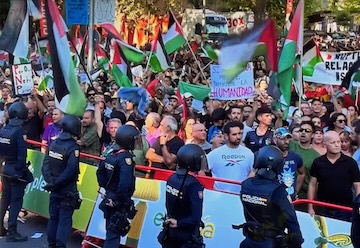
Since becoming editor at HopNews, I have considered covering professional cycling—a sport close to my family’s heart. However, I wasn’t sure how many professional cycling enthusiasts live in our community, so I hesitated to publish cycling content. Today’s events in Madrid, at least in my estimation, warrant attention.
What should have been a triumphant celebration through the streets of Madrid turned into an unprecedented debacle today as the final stage of the 2025 Vuelta a España was canceled due to pro-Palestinian protesters who took over the Madrid circuit. After watching this remarkable three-week journey across Spain, I don’t think anyone anticipated witnessing such a dramatic and controversial ending to one of cycling’s Grand Tours.
Imagine if 100,000 protesters stormed the field during the fourth quarter of the Super Bowl because they objected to one team’s name. Picture the NFL halting the game, canceling the Lombardi Trophy ceremony, and simply declaring whoever was leading at that moment the champion. That’s essentially what happened in Madrid today.
Jonas Vingegaard was confirmed as the champion of the Grand Tour, but without a podium ceremony and with no stage winner, as the Madrid finale was derailed. The Danish rider from Team Visma-Lease a Bike had effectively sealed his third Grand Tour victory yesterday on the brutal summit finish at Bola del Mundo. Still, today’s events robbed him and the other jersey winners of their moment of glory.
The Four Jersey Winners Denied Their Moment
The four jersey winners and the best team who should have celebrated on the podium today were:
- Red Jersey (General Classification): Jonas Vingegaard (Visma-Lease a Bike)
- Green Jersey (Points Classification): Mads Pedersen (Lidl-Trek)
- Polka Dot Jersey (Mountains Classification): Jay Vine (UAE Team Emirates XRG), confirmed as winner for the second successive year.
- White Jersey (Best Young Rider—under 24): American Matthew Riccitello (Israel-Premier Tech), who took the jersey from Giulio Pellizzari on the final mountain stage yesterday.
- Team Classification (Best Team): UAE Emirates XRG
The best team is determined by the three fastest riders from each team each day. The daily times are added throughout the race. The team with the lowest time wins. Time bonuses and penalties don’t affect team standings.
When there’s a team time trial, as was the case at the Vuelta, the team’s official time for the day is based on the time of their fifth rider to finish (or their last rider if fewer than five complete it). Riders who get dropped are timed separately.
Historic Disruption of Grand Tour Tradition
In the 79-year history of the Vuelta a España, which began in 1935, nothing quite like this has occurred. This marks the first time any Grand Tour has been canceled before its final stage was completed due to political demonstrations, since the 1978 Vuelta a España in San Sebastian.
Even considering the other Grand Tours—the Tour de France (first held in 1903) and the Giro d’Italia (inaugurated in 1909)—such complete cancellation of a final stage due to protests is virtually unprecedented in modern cycling.
A Grand Tour consists of three weeks of racing across 21 stages, covering approximately 3,500 kilometers. These races represent the pinnacle of professional road cycling, testing riders across flat stages for sprinters, mountain stages for climbers, time trials for specialists, and the overall general classification that crowns the ultimate champion.
The three Grand Tours—Tour de France, Giro d’Italia, and Vuelta a España—form cycling’s most prestigious competitions, with only the most elite riders capable of winning even one, let alone multiple Grand Tours. Vingegaard has now achieved three. He finished second in the Tour de France in July.
The Target of the Protests: A Troubling Double Standard
The demonstrations that plagued this Vuelta were directed at the Israel-Premier Tech team’s participation in the competition. What makes this targeting particularly troubling from a sporting perspective is that the team has no governmental connections whatsoever—it’s a private cycling team that happens to carry the Israel name through its title sponsorship.
The irony wasn’t lost on observers that while protesters demanded the exclusion of Israel-Premier Tech, the UAE Team Emirates XRG not only participated without incident but won the team classification. Congrats to UAE Team Emirates XRG, well deserved! The UAE has been a fixture in Grand Tour cycling for years, participating in all three Grand Tours, yet has faced no organized opposition despite the UAE government’s sponsorship. Government sponsors are nothing new. It doesn’t and shouldn’t matter.
Cycling has a history of government-sponsored teams. The US Postal Service sponsored Lance Armstrong’s dominant team for years—a team directly funded by a department of the United States government. While critics questioned whether taxpayer money should fund professional cycling, there were no mass protests demanding the team’s exclusion from races based on US foreign policy.
The Israel-Premier Tech team made desperate attempts to defuse the situation. In recent days, the team dropped the word “Israel” from their jerseys and rode in monogram-branded kits to protect their riders. This symbolic gesture proved futile as the protests continued unabated.
It’s even more of a shame when considering the personal story of Matthew Riccitello, a 23-year-old American from Tucson, Arizona, riding for Israel-Premier Tech. Riccitello secured a historic milestone during yesterday’s Stage 20 on the brutal climb to Bola del Mundo, where he overtook Italian rider Giulio Pellizzari in the young rider classification. Riccitello also finished fifth overall in the general classification, making it a remarkable debut Grand Tour performance.
It’s noteworthy that Israel-Premier Tech plans to remove “Israel” from its name and compete as Premier Tech next year.
Political Interference in Sport
What’s particularly concerning is the apparent political endorsement the protests received. Spain’s Prime Minister, Pedro Sánchez, applauded the pro-Palestinian protesters who had disrupted the race. At the same time, Foreign Minister José Manuel Albares said he would support the expulsion of the team from the race.
This represents a dangerous precedent in which private sporting teams become targets for geopolitical grievances over which they have no control. Professional cycling teams operate as commercial entities, not as extensions of government policy. If we accept this logic, virtually any team could become a target based on their sponsors’ national origins or perceived political associations.
The Racing That Was Lost
The chaos began as around 50 protesters ran onto the road during the finale today, blocking the peloton, which was then riding together in preparation for the final kilometers of the race. What followed was systematic disruption as protesters tore down barriers surrounding most of the 6.2-kilometer circuit, of which they were to race nine laps.
Jasper Philipsen, the Belgian sprinter from Team Alpecin-Deceuninck, has dominated the sprint stages this year, showing himself to be the best sprinter in the 2025 Vuelta with three stage wins. Today’s 9-lap circuit through downtown Madrid at those blistering speeds of 40-50 mph would have been ideally suited to his explosive finishing kick.
Winning the last stage of a Grand Tour is the ultimate dream of any sprinter. Just finishing a grand tour and being healthy enough to attempt the previous sprint is impressive, but having that chance stolen is a tragedy.
Despite deploying more than 1,500 police officers ahead of the final stage, authorities couldn’t contain what was reported to be more than 100,000 people who took part in the anti-Israel protest in Madrid.
Instead of celebrating sprint excellence and Grand Tour glory, we witnessed Jonas Vingegaard offering a muted fist bump of congratulations to his teammates and staff. The riders were ultimately led out of the city before they had even passed the podium in Madrid.
A Sporting Tragedy
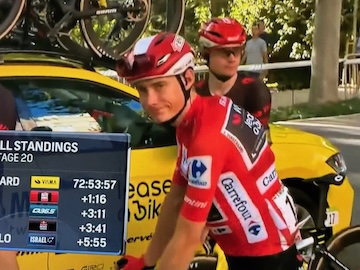
This Vuelta has been plagued by protests throughout its final week, with at least six of the last 10 stages interrupted or shortened by demonstrators. What should have been cycling’s celebration of athletic excellence became entangled in geopolitical tensions that had no place in professional sport.
While Vingegaard’s sporting achievement remains intact-his masterful performance on Bola del Mundo yesterday effectively sealed the title—the lack of a proper celebration robs the sport of one of its most cherished traditions.
The Grand Tour podium ceremony represents the culmination of three weeks of suffering, strategy, and triumph. Today, that tradition was stolen by forces that chose to punish athletes for their team’s name rather than focus on the remarkable sporting achievements we’ve witnessed over these three weeks.
In 79 years of Vuelta history, and over a century of Grand Tour tradition, we’ve never seen anything quite like this. Sport has always been meant to unite, not divide. Today, that principle was abandoned on the streets of Madrid, leaving a dark cloud over what should have been a celebration of human athletic achievement.



Thank you for this, I’m also a huge cycling fan.
Maybe if we all ban together, the silly bike lanes in town can be re-designed 🙂
They are embarrassingly stupid and deprive West Main of valuable space for emergency vehicles to pass.