 HopNews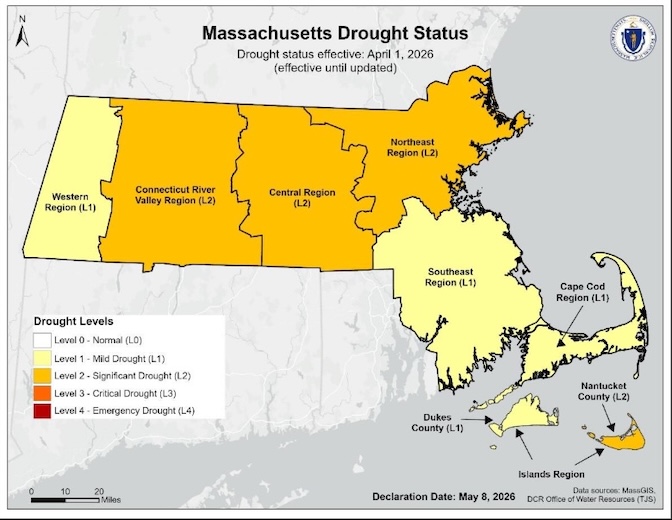
State Declares Worsening Conditions Across Massachusetts
Hopkinton residents are being asked to take meaningful steps to reduce their water use. This comes as state officials declared Thursday that the Central Region — which includes Hopkinton — has worsened to a Level 2 – Significant Drought.
The declaration came from Energy and Environmental Affairs (EEA) Secretary Rebecca Tepper. She announced the upgraded drought status on May 8 following a review by the state’s Drought Management Task Force (DMTF). The task force evaluated conditions spanning August 2024 through April 2026. This nearly two-year stretch brought below-normal precipitation. As a result, groundwater reserves have quietly depleted, streamflow has been reduced, and vegetation has dried out across the region.
What Brought Us Here
April was an especially dry month across Massachusetts, with most of the state receiving only 1.5 to 3 inches of rain — well below historical norms. While spring snowmelt offered some brief relief earlier in the year, it wasn’t enough to offset the longer-term deficit. Over the past three to six months, most of the state has received only 60 to 90 percent of its normal precipitation.
The effects go beyond dry lawns. Streamflow levels remain low. Groundwater continues to decline. Vernal pools and ponds are struggling, and fish migration patterns are being disrupted. In addition, vegetation and ground cover are drying out. This also raises the risk of wildfires as we head into summer.
“Recent rainfall has helped, but rivers are still running low, and groundwater levels remain below normal,” Secretary Tepper said in Thursday’s announcement. “These conditions reflect the longer-term dry period we’ve been experiencing. As we move through the growing season, many communities have water restrictions in place. Using water wisely, both outdoors and indoors, can help reduce stress on our water systems.”
What Level 2 Means for Hopkinton Residents
A Level 2 – Significant Drought designation comes with specific recommendations for residents, businesses, and local government. Hopkinton residents and businesses are strongly encouraged to:
- Minimize overall water use wherever possible
- Follow all local water use restrictions — check with your water supplier, as some systems may have stricter rules in place
- Limit outdoor watering to hand-held hoses or watering cans only, and use them only between 5 P.M. and 9 A.M.
- Fix indoor leaks from toilets, faucets, and showers — indoor leaks account for more than 60 percent of indoor water use
- Larger buildings and businesses should conduct water audits to find and address leaks and inefficiencies
Local governments in Level 2 areas are being asked to limit or prohibit the installation of new sod, seeding, and landscaping. They should also restrict washing of hard surfaces like sidewalks and driveways, and discourage personal vehicle or boat washing. Moreover, towns are also being asked to establish water-use reduction targets. They are encouraged to reach out directly to the highest water users.
Why Your Private Well May Be at Risk
Even if your water comes from a private well rather than the town supply, you are not insulated from drought impacts. The state notes that all water sources — municipal systems and private wells alike — draw from the same river basins. In particular, private well users should be alert to declining water levels. If your well is running dry or producing less water than normal, residents are asked to report the issue to their local Board of Health.
The Massachusetts Department of Environmental Protection (MassDEP) will continue to help communities manage their water systems throughout the drought. Notably, the Massachusetts Water Resources Authority (MWRA) system — which serves many communities in the greater Boston area — is not under a drought declaration under its own plan. However, private wells and other sources in the same basins are still affected.
Looking Ahead
The DMTF will meet again on June 8 at 11:00 A.M. to reassess conditions across the state. While some areas — including parts of Cape Cod — have seen slight improvements recently, the outlook for the Central Region depends heavily on whether the coming weeks bring consistent, above-normal rainfall.
Residents can monitor drought conditions and even contribute to the state’s tracking effort. The Massachusetts Water Impact Reporter allows anyone to report dry environmental conditions. Residents can also submit photos to help state officials monitor how drought is affecting local landscapes.
The bottom line for Hopkinton: the drought we’ve been experiencing is not a short-term blip. It has been building for nearly two years. Full recovery — especially in groundwater — will take sustained rainfall over many months. In the meantime, every gallon saved helps protect our water supply for essential uses like drinking water, fire protection, and local businesses.
Check with the Hopkinton DPW website to get the latest information.
For state-wide information on water conservation, visit the EEA’s drought and water conservation pages at mass.gov.
Sources: Massachusetts Executive Office of Energy and Environmental Affairs press release, May 8, 2026.



0 Comments