 HopNews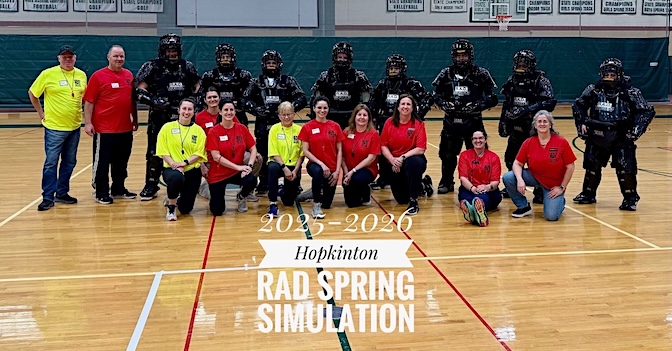
History of RAD in Hopkinton
What began in the early 1990s as a small self-defense initiative in Virginia has grown into a cornerstone of student life in Hopkinton.
Each year, the RAD (Rape Aggression Defense) program teaches hundreds of students not only how to defend themselves, but how to move through the world with confidence after high school.
Tim Brennan, a former Hopkinton police sergeant and longtime RAD instructor, started teaching the program in 1993. He trained at Bentley University, where one of the first RAD programs in the Northeast was offered.
After moving to Hopkinton in 1999, Brennan partnered with Officer Linda Higgins to bring RAD to the community. In 2008, the program was introduced at Hopkinton High School (HHS).
Today, Diane Maillet leads the RAD program at the high school. She took over in the fall of 2012. When she started, she taught one class each semester. Today, she teaches four.
The Goal
At its core, RAD is about confidence and awareness.
Brennan says the class is not just about physical techniques. It teaches students how to recognize danger, trust their instincts, and respond effectively.
“I think it’s the most important class a female will take before going to college,” he said.
Maillet shares a similar view. She says the goal is to provide students with viable self-defense options in dangerous situations and help them feel capable of protecting themselves. She also emphasizes that the class is open to all students and aims to create a supportive, inclusive environment.
Superintendent Evan Bishop sees RAD as part of the school’s larger mission.
“It’s one of the most important programs that we currently have,” he said. “It gives students physical and emotional self-confidence.”
RAD Simulation
The most intense yet crucial aspect of the RAD program is the final simulation, where students must physically defend themselves against an “aggressor” in a controlled setting.
Over the years, Brennan has not only served as a RAD instructor but has also taken on the role of an aggressor during student simulations.
He describes one of the most powerful aspects of the experience as “seeing the fear in the students’ eyes, but also the confidence.”
For Maillet, the transformation leading up to that moment is just as meaningful.
“Some students have never thought that they are capable of physically defending themselves,” she said. “To watch them go from that to completing a simulation, it’s awesome.”
Having taken the class myself as a student at Hopkinton High School, I experienced that moment firsthand. Despite my initial fear at the beginning of the semester, I walked away from the simulation feeling stronger and more confident.
I believe that every individual, especially females, should take a RAD class if given the opportunity.
Growing the Program
Despite its impact, expanding and maintaining RAD has been a challenge, largely due to limited funding, scheduling constraints, and the availability of trained instructors.
For Maillet, the biggest barrier is time and workload. As the only RAD instructor at the high school, she is responsible for organizing paperwork, coordinating simulations, and above all, supporting students individually.
She also noted structural barriers, particularly the unfortunate reality that not every student who signs up for RAD is guaranteed a spot.
Additionally, Maillet advocates for consistent involvement by town police, which she believes is critical to building trust between students and law enforcement.
“I want my students to have a relationship with an officer before they ever have to in a time of need,” she said.
In recent years, the connection between the Hopkinton Police Department and our school RAD program has been lacking. As a community, we should be able to count on the HPD to support important programs in our town.
According to School Committee chair Kyla McSweeney, a potential way to further support RAD could be through grants from organizations willing to fund the program.
Bishop acknowledged these gaps and the need for growth, sharing that “In a perfect world, it’s not a class students sign up for, it’s a class everyone takes.” However, making that vision a reality would require additional staffing, schedule adjustments, and funding.
Impact
The impact of RAD extends far beyond the classroom. As students leave Hopkinton for college and beyond, the program’s value remains clear: it empowers them to navigate the world with greater confidence, defend themselves if necessary, and recognize danger.
Maci Ober is a Hopkinton High School senior completing her Senior Capstone Experience with HopNews. This is her first article.
Article 1: Empowering Students: The Impact of RAD Explained
Article 2: A.I.’s Role in Academic Integrity at Hopkinton High School
Article 3: Hiller Mentoring Program Connects Hopkinton Schools
Article 4: Coming soon…



I hope Tim Brennan applies for the Chief of Police position!
I have gone through the program twice. The first time was with a friend who was in need of this training and I went for “support” but quickly found the value for myself. It is more than just a self defense class, it teaches situational awareness. I felt the transformation from fear to confidence in the simulation. Fast forward 10 years and I took it again with my 17 year old daughter and her friends. Every woman should take this class. We should support it in the high school.
Nice article Maci!