 HopNews
In recent years, legislators at the State House have recognized that there is a housing affordability issue in Massachusetts. This has been well-publicized, most recently in the Boston Globe with their excellent report entitled Beyond the Gilded Gates, which covered supply and demand issues as well as the cost of living and stagnant wages that have put home ownership out of reach for many of the state’s citizens.
Beyond owning a home, renting has become increasingly untenable for many. According to RentHop, the average cost to rent a 2-bedroom apartment in Boston is $3,250 per month, a 27% increase from 2020. With average household income in the Commonwealth at $84,385, this puts the cost of living for a Boston family at 46% of their pre-tax earnings, well above the 25-30% of recommended income to rent/mortgage payment rule.
The state legislature also concluded that affluent towns like Hopkinton are not likely to address the housing density problem on their own. In response, they amended the MGL’s, forcing communities to create “multi-family zoning as-of-right in MBTA communities“.
The new law went into effect in 2021, and initially required towns served by the transit agency to have at least one zoning district “of reasonable size” where multi-family housing is allowed within a half-mile of a commuter rail, subway, bus station or ferry terminal, if applicable.
For the uninitiated, a zoning district is a section of a municipality designated for a specific use, as defined by local zoning laws: Hopkinton has 12 zoning districts (Residential, Commercial, Agricultural, etc). In this case, the new zoning district would overlay an existing zoning area, meaning both types of development would be allowed in the zone. This is similar to the Hotel Overlay on South Street, which is zoned Industrial.
According to the state’s website, after the draft guidelines were issued, the Baker-Polito Administration held a public comment period and more than 24 engagement sessions, receiving nearly 400 comments through an online portal. The guidelines were then revised to expand the definition of a MBTA community to include towns that are adjacent to another town that hosts MBTA commuter services. Presumably this was to address the mathematical problem that including just towns within 1/2 mile of commuter services would not create enough multi-family housing stock to meet the anticipated demand. The revised guidelines brought the total number of MBTA Communities to 177.
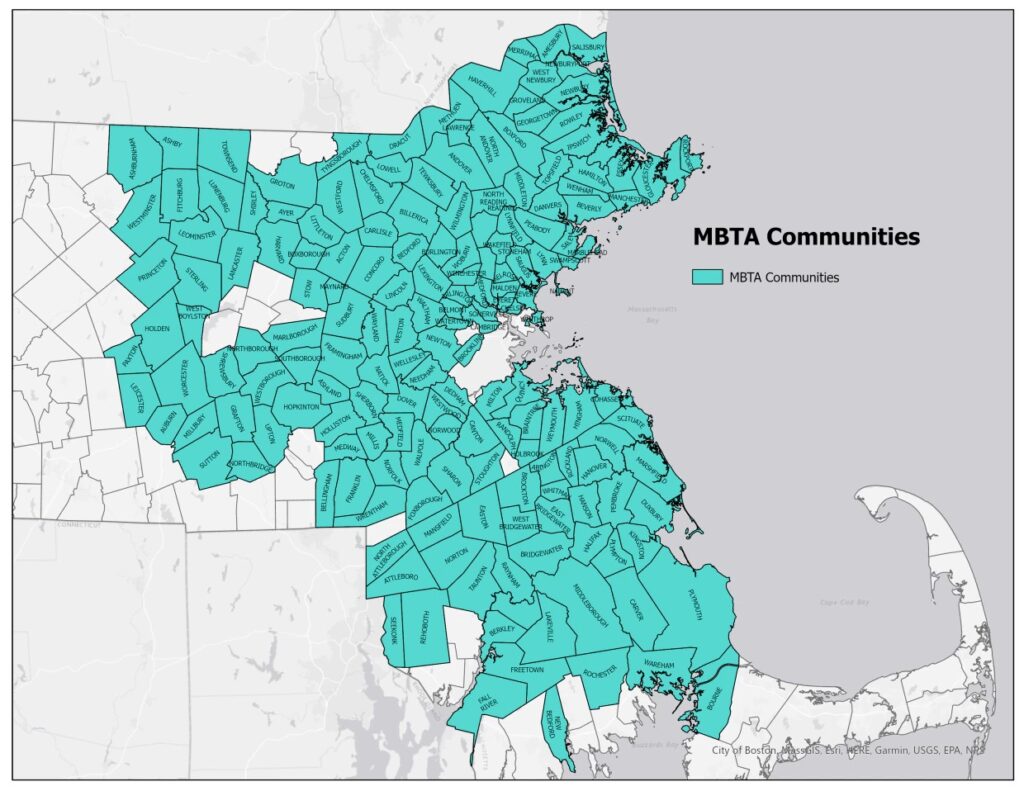
The guidelines also added a Tailored District Location Requirement. For communities that do not have at least 100 acres of contiguous developable land within 1/2 mile of MBTA services, they can now meet the requirements by creating multiple zoning areas, arriving at the minimum number of acres required, which is derived by a complex formula. In Hopkinton’s case, the required number of acres is 50.
In simple terms, to comply with the new law, Hopkinton must create one or more zoning overlays that add up to 50 acres in total. This computes to 750 additional housing units zoned with a density of 15 units per acre.
An important distinction is that these zoning overlays need to accommodate multi-family housing, not necessarily affordable housing, which is a different statutory definition. Additionally, the town is not required to build the units, it is simply required to zone for it.
These requirements are vexing Town planners across the Commonwealth.
“It’s difficult to implement a state initiative at the local level,” said Principal Planner John Gelcich. “In spite of the challenge, the Land Use department and the Planning Board will put forward an option that will meet state requirements and will hopefully be acceptable to the town.”
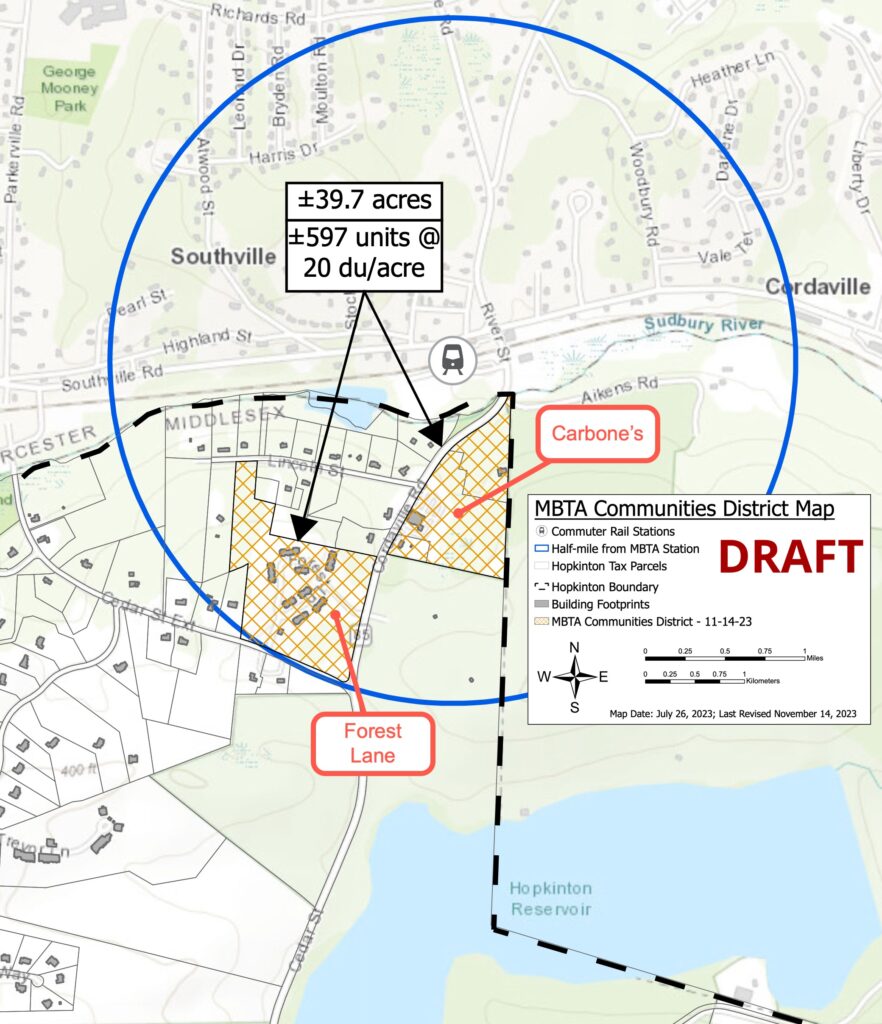
The Zoning Advisory Committee (ZAC) and Gelcich have identified two areas in Hopkinton that meet the requirements. The first area is the Carbone property, located at 280 Cedar Street, and just 0.3 miles from the Southborough MBTA station. This will be combined with the parcel across the street, Forest Lane, which currently holds townhomes.
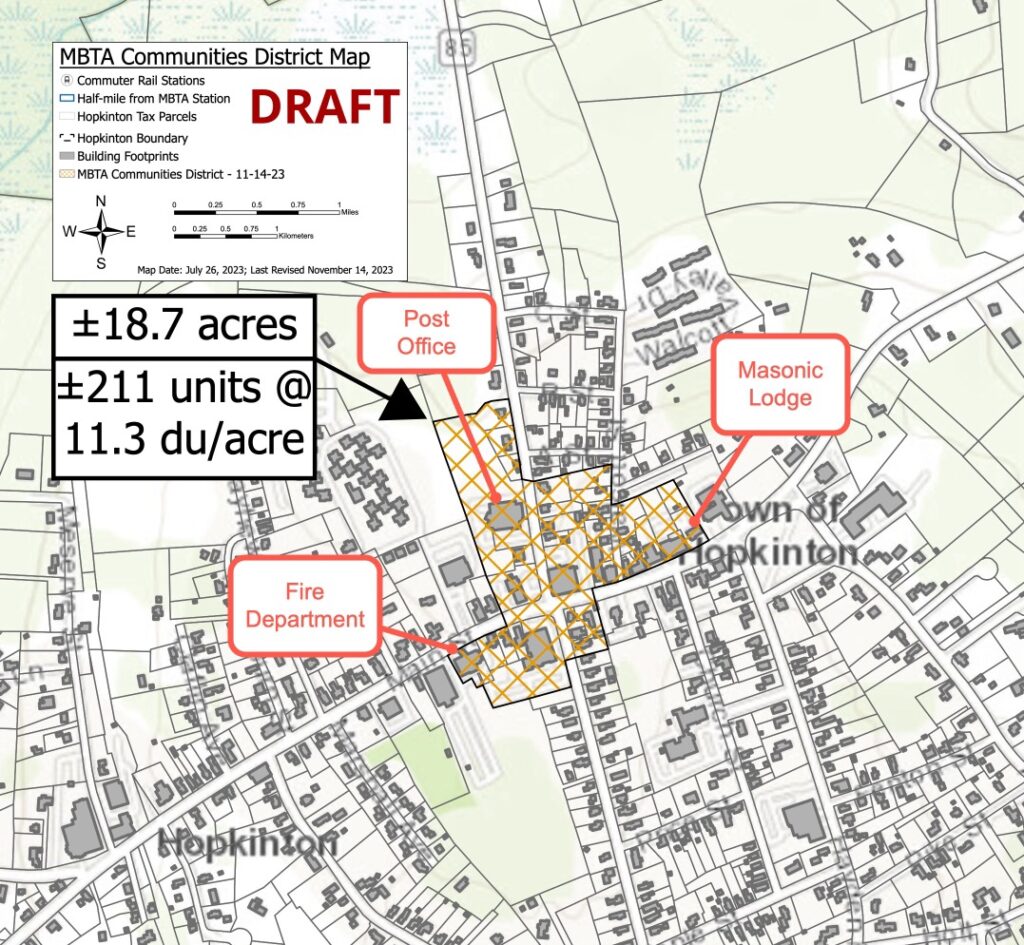
The second area spans a section of downtown Hopkinton, which could be ideal for mixed-use development. It would stretch from the Hopkinton Fire Department to just beyond the Post Office and to the Masonic Lodge.
The committee evaluated several other parcels, including Center School, Elmwood School and areas of South Street, but they were deemed unviable because they would risk reducing the commercial footprint of Hopkinton.
In the next few months, ZAC will formalize and present their recommendation to the Planning Board, who will then present the plan at Town Meeting for approval by Hopkinton voters this May. While the plan must be submitted to the state by December 31, 2024, the Planning Board cannot rely on a Fall Special Town Meeting taking place, which is why the plan will be presented this Spring.
The penalties for not complying are potentially severe. Municipalities risk ineligibility for more than 15 state grant opportunities, including Community Planning Grants, Land Use Grants and Municipal Vulnerability Preparedness Planning and Project Grants. Hopkinton receives several million dollars from the state each year, which supplements the town’s operating budget. The town of Holden was recently sued for refusing to comply. Holden does not host MBTA services but it is adjacent to Worcester, which does. The suit was dismissed on December 4, with the judge ruling that the plaintiffs lacked standing. However, Attorney General Andrea Joy Campbell has signaled that her office intends to aggressively enforce the law.
In March, the AG’s office issued an advisory to clarify her position: “Communities cannot opt out of or avoid their obligations by choosing to forego state funding. Failure to comply may result in civil enforcement action or liability under federal and state fair housing laws,” she wrote.
Hopkinton residents will rightly worry that approving multi-family housing districts will stress an already overpopulated school system, for which the legislature has offered no solutions. Residents in the towns of Reading and Marblehead have expressed the same concern. But Hopkinton, like 177 other communities in the Commonwealth, has limited options. The town either complies with the requirements or risks losing critical state funds and subjecting itself to a potential lawsuit.
It will be up to Hopkinton voters at the next Annual Town Meeting to decide, but the legislature has made it clear: In this matter, there really is no choice.


Nice work!
I find it interesting that on the one hand there is a hew an cry for affordable housing (and rightly so) for potential future residents of the town and yet a HUGE tax increase was just approved that likely will force out many of our current moderate/low income residents!
Unfortunately, I think much of the problem is a matter of geography. Boston was settled in the 1600’s and we’ve been crowded ever since. Even to the point where we filled in wetlands (ie. Back Bay) to make more room. And, in the case of the Boston area, we’re limited in areas to grow because of it’s location on the coast. Another limiting factor of “continued growth” is resources – water and waste disposal. Water sources, whether wells or reservoirs, are coming under increased pressure from residential/commercial growth in addition to the impact of the pollution that often accompanies it.
So what’s to be done? Perhaps we need to re-evaluate the idea that the land and environment can support the continued population growth that seems to be happening – whatever the income bracket of that population.