 HopNews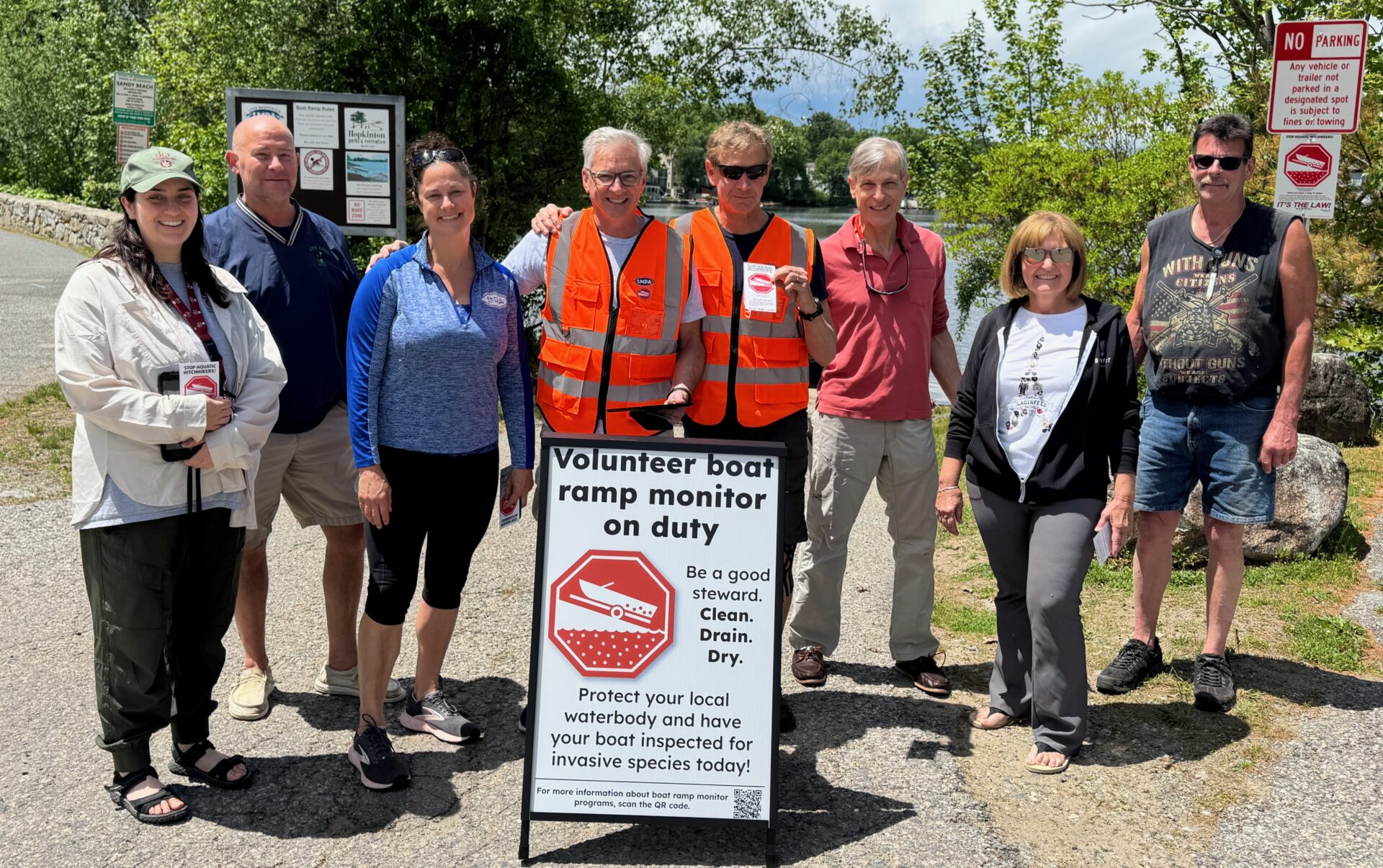
L to R: Toni Stewart from DCR, Ed Bouvier, Sabine St. Pierre, Don Doucette, Scott Colwell, Pete McDermott, Karen Campos, Shaun Smith
A new volunteer monitoring effort at the Sandy Beach boat ramp aims to stop a familiar threat before it spreads: invasive aquatic plants and other organisms that can hitchhike on boats, trailers, kayaks, fishing gear, and jet skis.
The program follows guidance from the state Department of Conservation and Recreation’s (DCR) Boat Ramp Monitor Program. Its goal is simple. Help boaters check their equipment before entering or leaving Lake Maspenock, remove any plant fragments or debris, and teach people how to avoid carrying invasive species from one water body to another.
A First Line of Defense
DCR describes boat ramp monitors as the “first line of defense” against aquatic invasive species. The agency’s program is used at both infested and uninfested lakes and ponds across Massachusetts.
At Sandy Beach, volunteers are being trained to greet boaters, explain the purpose of the checks, and ask whether they are willing to participate in a brief inspection and survey. The process is voluntary, educational, and meant to be quick.
Monitors are not there to block people from using the ramp or to create conflict. Volunteers should stay friendly, avoid confrontations, and focus on helping boaters understand what to look for.
The approach is practical. A plant in one body of water can be a native species. Yet, in another body of water, it can be invasive. That’s because ecosystems are local, not just regional.
When a plant exists in one body of water, it is held in balance by water chemistry, depth, light, sediments, fish, competition, or disease. In another body of water, some of those checks can be missing. This allows the plant to grow faster than the existing vegetation and crowd it out.
Aquatic plants spread by hitchhiking. A small bit of a plant that is caught in a propeller or stuck in a kayak strap can move from one lake to another. Sometimes, that’s all it takes.
For that reason, monitors are trained not to ask boaters to identify every plant. The message is simpler: don’t transport anything.
What Boaters Can Expect
Boaters will see volunteers wearing official-looking vests standing near the boat ramp. The volunteers may ask where the boat or jet ski was last used and if it was cleaned afterward. They will likely ask the boater if they are willing to let them look over the boat, trailer, and gear. The volunteers are not trying to catch the boaters doing anything wrong. Rather, their purpose is to educate.
Monitors look for plant fragments, mud, mussels or standing water. They may ask whether drain plugs have been pulled and whether live wells, bilges, ballast tanks or cooling systems are empty and dry.
If material is found, volunteers may ask permission to remove it. They are trained not to touch private property without consent. Removed plants or debris can be placed in a bucket and disposed of away from the water so rain does not wash it back into the lake.
Volunteers will give boaters an educational handout. It will explain basic prevention steps, including cleaning, draining, and drying boats and equipment.
Data Collection, Not Enforcement
The Sandy Beach effort includes a data-collection component. DCR uses a survey platform called Survey123, which can be loaded onto a tablet or other device. The survey records basic (anonymous) information, such as the type of vessel, where it was last used, whether it was inspected, and whether any organisms were found.
If a monitor finds a plant or other organism, the survey allows them to take a photo. DCR staff can then review the image and determine what it is. Volunteers were advised to photograph samples against a light background, ideally with the material wet, because dry plants can be harder to identify.
DCR’s broader goal is to gather statewide data that can help officials understand how aquatic invasive species move across Massachusetts and neighboring states. Lake associations, municipalities, and other groups can use the same DCR survey to ensure information is collected consistently.
The survey is anonymous. It is used to understand the spread of aquatic invasive species, not to identify individual boaters.
Lake Maspenock Matters
Lake Maspenock is one of Hopkinton’s most visible recreational resources. It is used by residents, anglers, paddlers, beachgoers, and visitors. The Sandy Beach ramp is the point of entry for boats and other watercraft that may have been used on other lakes.
The Boat Ramp is an Important Checkpoint
Volunteers discussed how busy launch times can be, especially on weekends or during fishing events. Monitors will not reach every boat. The program is a trial, with volunteers covering selected hours rather than providing round-the-clock coverage.
Still, DCR’s position is that some monitoring is better than none. Each conversation serves as another reminder for boaters to clean their equipment. Each inspection may stop material from entering or leaving the lake.
Volunteers discussed the possibility that prevention could reduce the need for future treatment efforts. Preventing new invasive species from entering the lake is less costly and less disruptive than managing them after they become established.
There Are Laws
Under Massachusetts law and DCR regulations, boaters may not launch a vessel, trailer, or related equipment into inland waters with plants, animals, or other aquatic nuisance material attached unless it has been properly cleaned or decontaminated.
If a boat appears contaminated, or if a boater’s answers indicate they were in infested waters and did not decontaminate, monitors can explain that launching is illegal under M.G.L. c. 21, § 37B and 302 CMR 18.
Volunteers are NOT Policing
If a boater refuses to participate or launches in violation, volunteers will not physically stop a boater or put themselves in a confrontational situation.
Volunteers are there to serve boaters and the lake. The goal is to protect Lake Maspenock, not to accuse people of wrongdoing.
Changing Habits
The long-term success of the program may depend less on one inspection and more on repetition. The more often boaters see monitors, signs, and brochures, the more likely clean boating practices become routine.
A boater who learns to check a trailer before launching at Sandy Beach may do the same thing at another lake. A kayaker who removes weeds before leaving Lake Maspenock may avoid carrying them elsewhere.
For volunteers, the work is simple but important. A few minutes at the ramp can help protect a lake that many residents use and value.
At Sandy Beach, the message to boaters is straightforward: clean off your boat, drain standing water, dry your gear, and do not let invasive weeds hitch a ride into Lake Maspenock.



0 Comments