 HopNews
You don’t really notice the shortest day of the year when it first arrives. It just slips in. One moment you’re looking out the window, and dusk is already creeping up. The sun barely makes it above the rooftops, skimming the edge of the sky. Right when you think the darkness can’t get any deeper, there’s a subtle shift—so slight you almost miss it. That’s the Winter Solstice.
The darkest day doesn’t just mark the depths of winter—it signals that the light’s on its way back. Earth tilts at a quirky 23.5 degrees, so when our part of the world leans away from the Sun, we hit the Winter Solstice. Most years, this happens on December 21 or 22. Though it can shift a little since the calendar and Earth’s orbit don’t sync up perfectly. The solstice hits the moment the Sun sits farthest south of the celestial equator, right above the Tropic of Capricorn. When the Sun swings north, over the Tropic of Cancer, that’s when we get the Summer Solstice.
On these days, the sun lingers near the horizon, crawling through the shortest arc of its journey. Daylight shrinks to the bare minimum. Night stretches out, taking over, but only for a moment. The darkness comes out on top, but just for a breath.
People have watched this turning point for thousands of years, long before anyone thought to mark dates on a calendar. They saw the sun shift and understood; something important was changing, even when the world looked frozen and still. The light would return.
Neolithic Builders Paid Attention
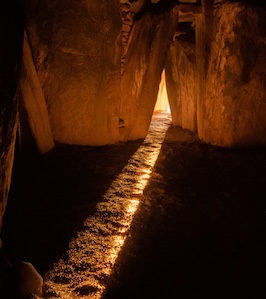
Ancient people didn’t just notice; they built giant stone calendars. Take Newgrange in Ireland, finished around 3200 BC. On the Winter Solstice, just for a few minutes, the rising sun lines up perfectly. A single shaft of light slides down a long passage and hits the inner chamber. It illuminates a place that’s dark the rest of the year.
They appear to have built that for this moment. It’s more than a monument; its astronomy etched in stone—a way to anchor survival to the sky.
Roman Traditions: Saturnalia and the “Unconquered Sun”
In Rome, the Solstice brought Saturnalia—a week of wild celebration, gifts, feasts, and even swapping social roles. After Saturnalia came Sol Invictus, the festival of the “Unconquered Sun.” Both festivals circled the same idea: after the darkest stretch, the sun would rise again, stronger than before.
The Yule
Up north, it was Yule. Norse and Germanic people marked midwinter with fires, feasts, and evergreen branches. Light wasn’t just a symbol—it was survival. These gatherings made the cold less harsh. They gave people something to hope for.
Today, the Solstice is this odd mix of science and deep-rooted feeling. We know the astronomy, but the day still matters. For many, this is when the new year really begins, never mind what the calendar says. People celebrate in all sorts of ways:
- Lighting candles or building a fire to greet the sun’s return.
- Sharing a meal, spending time together—at home, or wrapped up outside.
- Taking a walk under the longest night, maybe watching for stars.
- Using the pause to reflect, make plans, or set goals.
Even if you skip the traditions, the Solstice gives you a moment to stop. It’s a turning point, a quiet nudge that real change usually starts in darkness, before you even notice.
About the Timing
Lots of people think the shortest day means the earliest sunset or the latest sunrise. It doesn’t work like that. The Solstice brings the least daylight. The sun stays lowest, but sunrise and sunset shift for a different reason: the equation of time. Earth’s tilt and its slightly off-center orbit mess with the clock. Solar noon drifts around the Solstice, so sunrise and sunset don’t line up evenly.
Usually, the earliest sunset happens before the Solstice, and the latest sunrise comes after. The Solstice still gives us the shortest day, even if your watch disagrees. The farther north you live, the more you notice these quirks. Our calendars aren’t a perfect match for Earth’s orbit. The Solstice can move a day or so each year.
A Lasting Turning Point
The Winter Solstice sticks around in our minds for a reason. Sure, it’s an exact moment in astronomy, but it’s also personal. It’s about patience, endurance, and that slow, stubborn return of hope. At first, the days only gain a few seconds of light, but that’s how every new season gets going. In the heart of winter, we remember that renewal starts small and keeps on growing.
Editor: This is dedicated to one of the most intelligent people I have ever known, John Shane, PhD. During our many runs together, John took the time to explain lots of things, including astronomy. I even studied the constellations we’d see before hiking the Grand Canyon with John. He was impressed. I remember my husband getting frustrated with me because I asked John what a “black hole” was. “Why do you do that?” Walter asked, knowing neither of us would understand him after his initial, “Well…” One year, we ran in Callahan State Park on the Winter Solstice. John explained why December 21 was not always the year’s earliest sunset. I always remember John fondly on this day.
“I hope I did it justice, John. I sure do miss you!”



What a great peace. Thank you (and John)!