 HopNews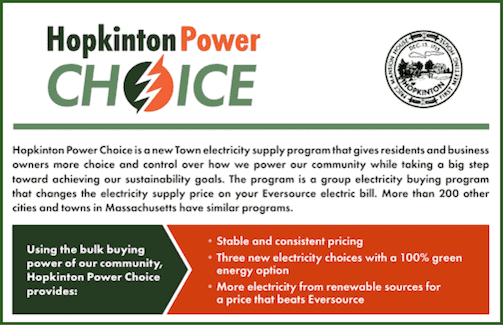
One of our readers recently asked us to research the Hopkinton Power Choice program and explain it in clear, simple terms, as they were confused by the information received in the mail. We’ve explored the program in depth and attended a presentation at the library by the consulting company overseeing it. We believe residents have several good options to consider. Here’s what we found.
Hopkinton is launching an electricity program that leverages the collective purchasing power of its residents and businesses to secure more favorable energy rates and cleaner power sources.
Hopkinton Power Choice is scheduled to commence in September 2025. It represents a municipal aggregation program offering 24 months of price stability, renewable energy options, and potential savings compared to traditional utility rates.
What is Municipal Electricity Aggregation?
Municipal electricity aggregation is essentially a form of group purchasing of electricity. The program leverages the collective buying power of the community, enabling local governments to aggregate the electrical demand of customers within their borders to negotiate competitive electricity supply contracts. Rather than individual residents and businesses purchasing electricity separately from various suppliers, the municipality acts as a single buyer, leveraging collective purchasing power to secure better rates and terms.
In Massachusetts, this approach has proven to be successful, with more than 200 communities already operating similar programs. The process is regulated by state authorities to ensure consumer protection and fair pricing, making it a transparent alternative to the private electricity supply offers that residents typically receive through mail, phone, or door-to-door sales.
Why Hopkinton Chose This Path
Hopkinton’s decision to implement a Power Choice program stems from several key objectives that address common concerns about electricity costs and environmental impact:
Price Stability and Predictability: Traditional Eversource basic service rates fluctuate every six months based on volatile market conditions. Residents may remember when the war in Ukraine began and electricity prices soared to 14-year highs. Hopkinton Power Choice offers fixed pricing for 24 months, from September 2025 through September 2027, providing predictable electricity costs without the volatility that typically affects the supply portion of electric bills.
Environmental Leadership: Hopkinton has prioritized buying more electricity from renewable sources. The program automatically provides participants with additional renewable energy beyond state-mandated minimums, supporting the community’s environmental goals while maintaining competitive pricing.
Community Control and Transparency: By managing their electricity procurement, Hopkinton residents gain more control over their energy future through a regulated, public, and transparent process that contrasts with private market offers.
Competitive Savings: Research by the University of Massachusetts Amherst examined similar programs statewide and found that communities typically achieve savings compared to fluctuating utility rates throughout electricity supply contracts. While no one is “buying a vacation home with the savings,” residents do save money on average.
Understanding Your Electricity Bill
To understand how Hopkinton Power Choice works, it’s essential to know that your total Eversource electric bill consists of two main charges: delivery charges and supply charges. Delivery charges cover the infrastructure and various regulatory fees, while supply charges cover the actual electricity.
Hopkinton Power Choice impacts only the supply portion of your bill. Eversource will continue to own and maintain the delivery infrastructure, handle billing, and provide customer service in the event of a power outage. Nothing changes about your relationship with Eversource except the company that purchases your electricity and the price you pay for that supply.
The Partnership with Direct Energy
Hopkinton has partnered with Direct Energy, an established electricity supplier that has been in business since 2004 and entered the Massachusetts aggregation market in 2018. Direct Energy currently serves over 50 aggregation programs in Massachusetts, including Cambridge, Worcester, and Sudbury, and operates similar programs in New Hampshire, Illinois, Ohio, and New York.
The consulting group managing Hopkinton’s program has found Direct Energy to be among the most responsive and professional suppliers with whom they work. Senior management is readily accessible when problems arise and works diligently to resolve issues, while the company maintains a strong track record of avoiding major operational mistakes.
The Four Program Options
First, it’s essential to note that, as of 2025, Massachusetts law requires the state’s electricity to derive at least 63% of its energy from renewable sources. No matter which option you choose, 63% of your electricity will come from renewable sources.
Hopkinton Power Choice offers residents and businesses four distinct options to match different preferences and budgets. All prices are fixed for 24 months and quoted in cents per kilowatt-hour:
1. Hopkinton Basic (13.97¢/kWh)
This lowest-priced option provides the same electricity mix you currently receive from Eversource, but at a competitive rate. You’ll still receive the state-mandated minimum renewable content (currently 63% renewable energy, with 27% (of the 63%) from newer renewable energy projects in New England). It provides no additional renewable energy beyond the 63% required by law.
This is the least expensive option and must be specifically requested; it is not the default enrollment choice. Remember, you are still getting 63% of your electricity from renewable sources, just not the 63.3% + 15% as you would get in the auto-enrollment default below.
2. Hopkinton Standard (14.59¢/kWh) – Auto-Enrollment Default
This middle option represents the program’s default choice, which includes Hopkinton’s commitment to environmental leadership. Participants automatically receive an additional 15% of their electricity from renewable sources beyond the state-mandated minimum. This means you’ll get 78% renewable energy (63% + 15%) while paying less than Eversource’s projected rate. The town chose this as the default because it prioritizes renewable energy while maintaining competitive pricing.
3. 100% Green Option (16.84¢/kWh)
For residents who want to make the most substantial environmental commitment, this option provides 100% of electricity from renewable sources. While slightly more expensive than Eversource’s introductory service rate, it offers complete coverage for renewable energy. This choice must be specifically requested and appeals to those for whom environmental impact is a top priority.
4. Eversource Basic Service (Stay with Current Provider)
Residents can choose to remain with Eversource’s basic service, which currently costs approximately 15.58¢/kWh for the six months from August 1, 2025, through January 31, 2026. However, this price will change again in February 2026 and continue changing every six months thereafter, providing no long-term price predictability.
Environmental Impact and Benefits
The program’s renewable energy comes from newer renewable energy projects in the New England region, excluding biomass sources. By purchasing from newer projects, the program builds demand that encourages the development of additional renewable energy infrastructure. The available renewable energy sources are primarily wind and solar, with wind comprising the majority of voluntary renewable energy purchases.
According to the town’s estimates, the initial implementation of Hopkinton Power Choice is expected to result in a 5-6% annual reduction in greenhouse gas emissions for the community, based on current pricing and participation projections.
How Enrollment Works
Massachusetts law requires all municipal aggregation programs to use automatic enrollment for eligible customers. Suppose you currently have Eversource basic service (meaning you don’t have a private electricity supply contract). In that case, your account should be eligible for automatic enrollment in September 2025, with the program price appearing on your October 2025 bill. Eligible customers should have received formal notification in the mail bearing the town seal.
Account Block: If you have Eversource basic service but didn’t receive a notice, you may have a customer block on your account. Some residents have requested these blocks in the past to avoid unwanted marketing from private suppliers. You can call Eversource to check for blocks and request their removal if you want to participate.
Flexibility and Consumer Protection
Participation in Hopkinton Power Choice is entirely voluntary, with several essential protections:
No Mandatory Participation: You can opt out before enrollment or at any time after enrollment without incurring any fees or penalties.
No Minimum Participation Period: You can participate for as little or as long as you like, whether that’s a few months or the full 24-month contract term.
Guaranteed Pricing: The program’s prices are fixed, regardless of the number of residents participating. Even if your neighbors opt out, your price remains unchanged.
Easy Transitions: Eversource doesn’t charge fees to return to their basic service, and you can switch between program options or leave entirely without penalty. The fact that you don’t have to stay in the program for the full 24 months is a significant advantage.
Special Circumstances
Existing Private Contracts: If you currently have a private electricity supply contract, you’re not eligible for automatic enrollment but can join by calling the program. Check your contract terms for any early termination fees before switching.
Solar Panel Owners: If you have solar panels or participate in Community Solar, your credits and incentive payments will continue unchanged. The program won’t affect these calculations, and your credits may be more effective if your underlying electricity bill is lower.
Budget Billing: If you use Eversource’s budget billing service (where you pay the same amount each month), participation in Hopkinton Power Choice will change how this works. The delivery charge portion will remain budgeted and consistent every month. Still, the supply charge will be calculated based on actual usage each month, resulting in a slightly varying total bill.
Low-Income Discounts: All existing Eversource low-income discounts and fuel assistance benefits continue unchanged with no impact from program participation.
Financial Comparison and Savings
Historical analysis reveals that over the past three and a half years, spanning seven different Eversource basic service rate periods, there has been only one instance where Eversource’s rate was lower than the proposed Hopkinton Standard rate of 14.59¢/kWh. This suggests consistent savings potential over time.
The program website features a calculator that enables residents to compare program prices with recent 12-month averages of Eversource’s changing rates, providing perspective on long-term value, as individual six-month rate comparisons can be misleading.
Managing Your Participation
The program website serves as the central hub for all program activities. The site provides current pricing information, including up-to-date Eversource rates as required by regulation. It features simple enrollment, option change, and opt-out forms that require only your Eversource account information.
Website: https://www.masspowerchoice.com/hopkinton
FAQ: https://www.masspowerchoice.com/hopkinton/resources/faq
Phone: 1-800-538-8435
Email: support@HopkintonPowerChoice.com
The website also includes bill explanation resources, calculators, and comprehensive program information.
Contract Renewal and Future Pricing
When the current 24-month contract expires in September 2027, Hopkinton will negotiate a new contract with pricing based on the then-current market conditions and the number of participating residents. Historical data suggest that approximately 90% of eligible residents typically participate in municipal aggregation programs, providing consistent purchasing power for future negotiations.
While the program cannot guarantee future savings, the collective purchasing power of community participation generally helps secure competitive rates compared to individual utility pricing that fluctuates every six months.
Program Timeline
Hopkinton Power Choice will launch in September 2025, with eligible customers seeing the program price on their October 2025 bills. The fixed pricing structure provides 24 months of stability through September 2027, contrasting with Eversource’s semiannual rate changes, which offer no long-term predictability.
Making Your Decision
For Hopkinton residents and businesses, the Power Choice program provides a locally controlled alternative to both volatile utility pricing and private supplier marketing. The program’s emphasis on price stability, renewable energy options, and community control aligns with broader trends toward municipal energy programs across Massachusetts.
The 24-month fixed pricing structure provides significant advantages over traditional utility rates, offering predictability during a period when energy costs remain volatile. Combined with the program’s environmental benefits and local control, Hopkinton Power Choice represents a forward-thinking approach to community energy management that prioritizes the interests of its residents.
For enrollment, option changes, or additional information about Hopkinton Power Choice, please visit hopkintonpowerchoice.com or call customer support (1-800-538-8435)—the program launches in September 2025 with 24-month fixed pricing through September 2027.



So let me get this straight, and please correct me if I’m wrong. Under Eversource the first half of 2025 is $0.13241 and the second half is $0.14884 for “fixed” rates. Under monthly rates it fluctuates between $0.11 and $0.22
Under the Choice program, the least expensive option is $0.1397 running up to $0.1684 for the green choice.
I am all for people having a choice, but I’m not seeing any benefit to my wallet for the current high energy prices in the state. Am I missing something here?